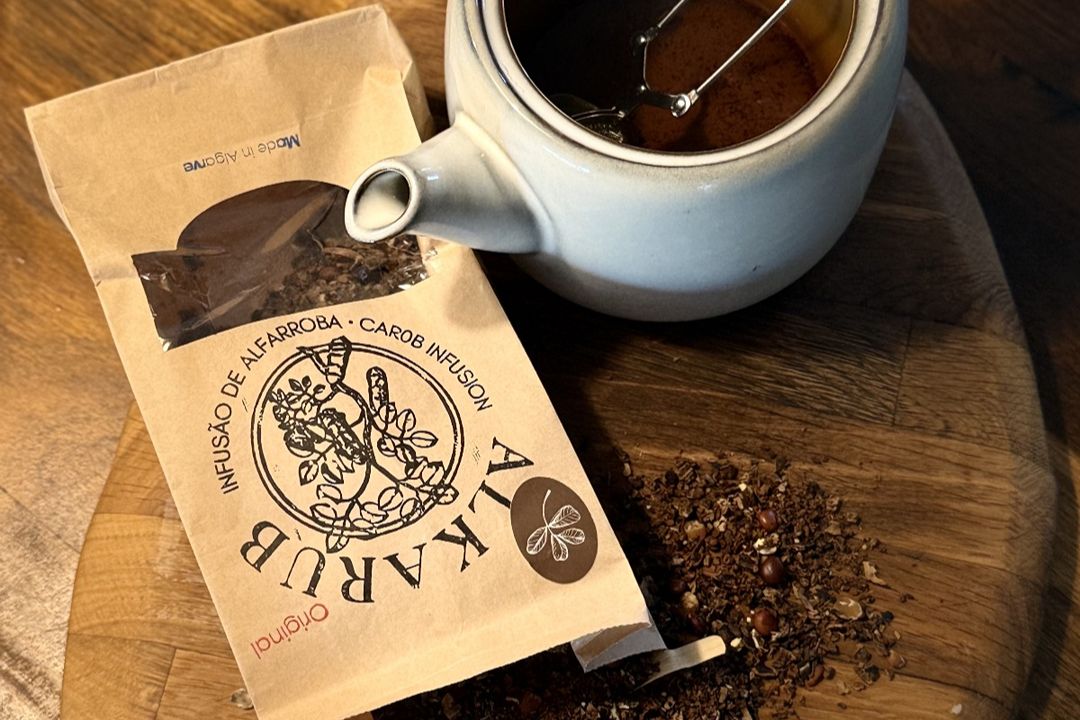
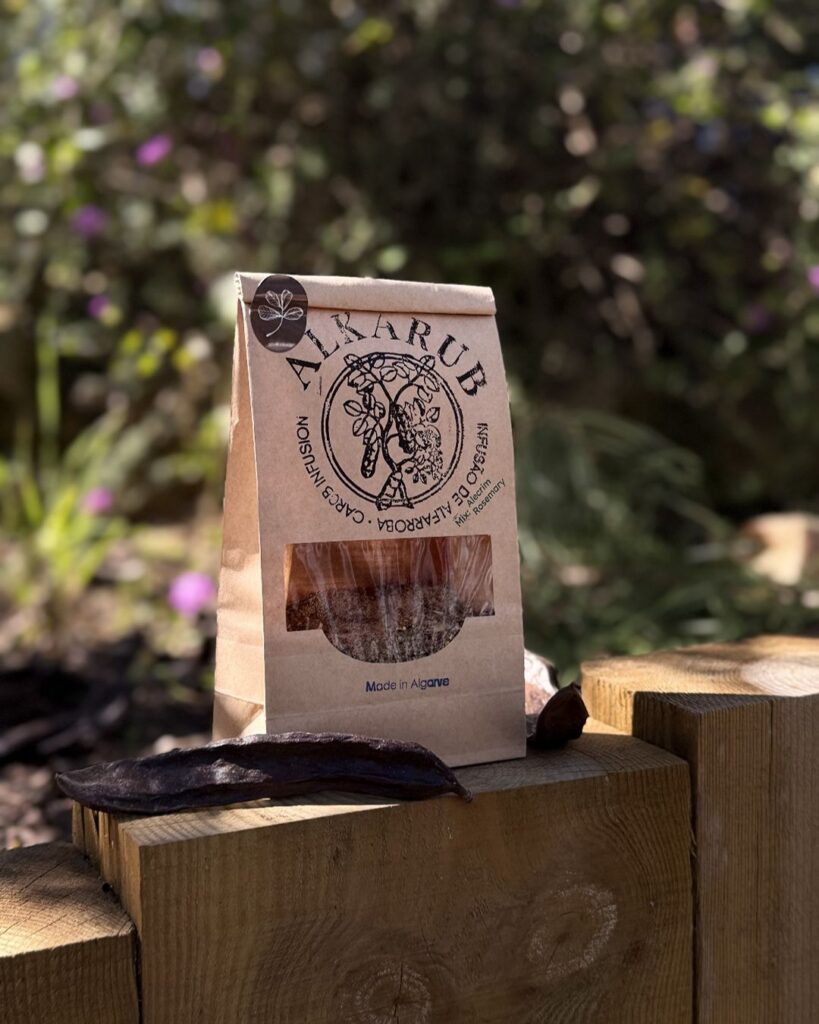
Living in the Algarve, the humble carob tree (Ceratonia siliqua) is part of the scenery. We park under them for shade, we step on their dark pods on our autumn walks, we know them as the region’s ‘black gold’ and a new superfood. But I learned a whole lot more when I connected with Joaquim Lourenço, the entrepreneur behind Alkarub, who is turning a childhood memory into a sustainable statement.
A recipe frozen in time
Like the best Algarve stories, Alkarub began at home. For Joaquim, the inspiration wasn’t a market trend, but a sensory memory dormant for over four decades.
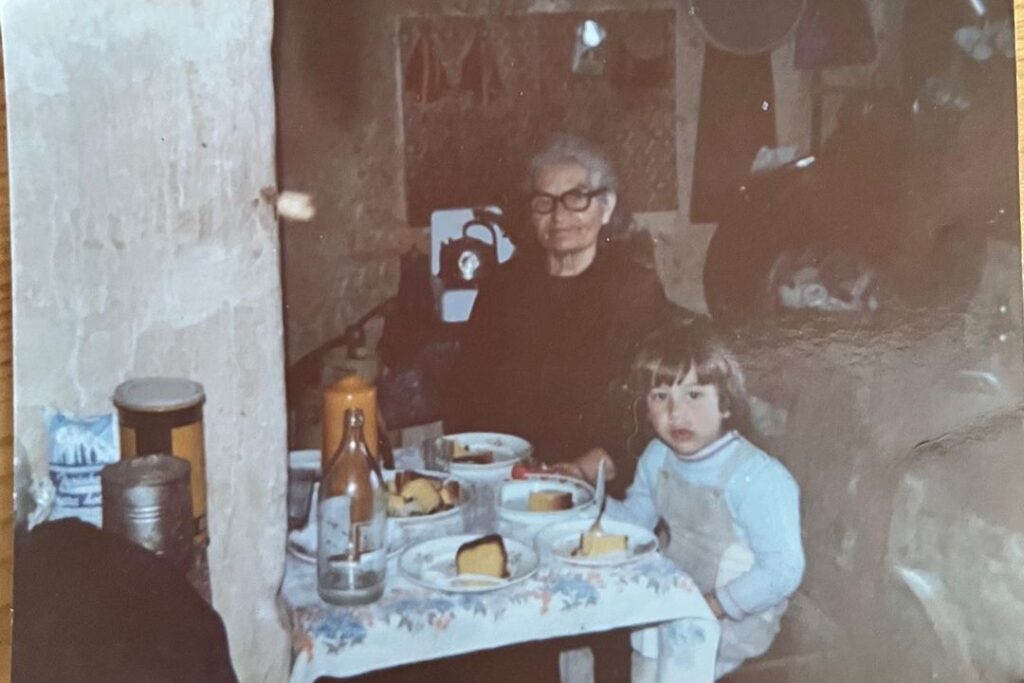
“When I was a kid, my grandmother sometimes used to make a carob infusion – we had it as a cosy drink sometimes – it was sweet,” Joaquim recalls. “I just forgot about it for 40-something years. One day I was just at home, and I just remembered the flavour and I thought that maybe I could try to create the same taste.”
The result was a rediscovery of that “cosy” feeling. After recreating the brew, Joaquim was surprised to find a gap in the market: “There’s no carob tea anywhere, not in Portugal, not in Spain, not anywhere.” This realisation sparked the creation of Alkarub, a brand dedicated solely to carob infusions.
Sustainability in the DNA
Joaquim is no stranger to green business. As the founder of Salema Eco Camp, which he describes as “the biggest ecological campsite in Europe, which is carbon neutral with zero waste”, sustainability isn’t just a buzzword for him. “It’s just part of my DNA. Everything I do is always around that value of preserving the real thing,” he explains.
This philosophy permeates every bag of Alkarub. The production is unapologetically slow and small-scale. “My products, yeah, they are 100% artisanal. I get the carobs, I grind them, I choose them, select them by hand,” Joaquim says.
In a world obsessed with automation, Joaquim has found a different rhythm. “It’s all packaging by hand, so instead of watching TV in the evening or watching a football game, I like to be printing labels or cutting the stickers … it takes time, but you can say it’s also therapeutic for me.”
Alkarub is naturally sweet, so no added sugar is needed. The tea is also caffeine-free, making it a perfect evening alternative to traditional teas or coffee. By the end of this year, Joaquim aims for the carob supply to be fully certified organic, and the brand is working to have its carbon footprint calculated, potentially making it the first carbon-neutral tea brand.
The history bit
While Alkarub is new, the ingredient is ancient. Joaquim is quick to point out that the Algarve shares a climate and botanical history with the entire Mediterranean basin, from Jordan to Sicily.
“Carob is for us, the people of the Mediterranean, has the same value as the coconut tree for the tropics because the carob provides food, shelter, wood to burn and also soil,” Joaquim notes.
Carob trees are crucial to the region’s economy and landscape, often found in traditional “dry orchards” (pomar de sequeiro) alongside almonds, olives, and figs. They were first introduced by the Arabs. Carob pods were historically vital as a food source during times of famine. The sweet pods were used for flour and syrup, and have now become a popular chocolate substitute.
The history of the pod goes back thousands of years. “The glue that the mummies of Egypt were wrapped in was made of carob,” Joaquim tells me. Perhaps most fascinating is the carob’s contribution to commerce. The seeds are remarkably consistent in weight (0.02g), which led ancient traders on the Silk Road to use them as a standard measure for gemstones. “One diamond could weigh five carats, five seeds of carob. And the ‘carat’ remains,” Joaquim explains.

A shield for the landscape
Today, Alkarub is more than a beverage; it is an act of resistance against changing agricultural trends. Joaquim is concerned about the removal of ancient trees to make way for thirsty tropical crops.
“They are taking out trees that are thousands of years old … to plant avocados or mango. And they are just destroying part of our cultural heritage,” he warns.
By creating value for the carob, Alkarub hopes to give farmers a reason to keep the trees standing. “Imagine that each tourist buys one product. That will save all the inland business, the workers, the farmers,” Joaquim argues. “The lands will not be filled with avocado trees in the future. This is also like preserving our own biome.”
It seems Alkarub is proving that looking back to our grandmothers’ recipes might just be the best way to move forward. As Joaquim puts it, “It’s more like a statement. Yes, anything is possible.”
Did you know?
The chocolate connection: after the 1974 revolution, when chocolate supplies from former colonies such as São Tomé and Príncipe dwindled, producers discovered they could mix carob flour with cacao to stretch their supplies. It was the first time carob was used in mass production.
Ancient history: the oldest known carob tree in Portugal is located near Moncarapacho and is over 600 years old.
A superfood: carob has experienced a modern resurgence as a “superfood”, with its high-fibre, gluten-free properties.