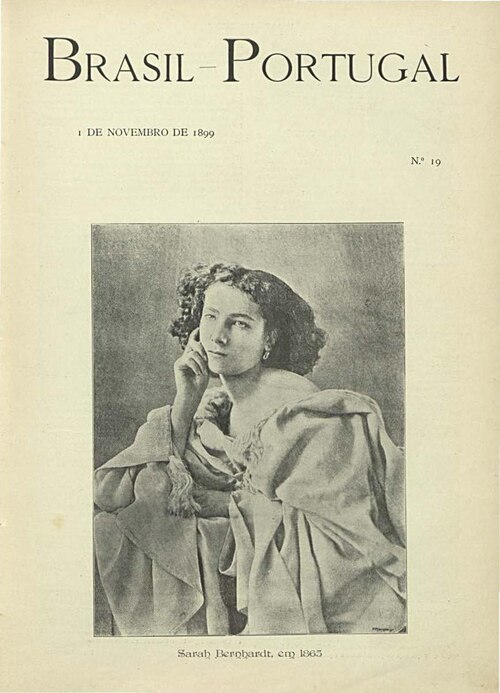
—Sarah Bernhardt: The Divine Impact on the Portuguese Theatre—
Words & translations: Dan Costinas
Photo credits: Wikimedia Commons
What happens when a French diva, starstruck royalty and obsessed fans collide? Long before modern celebrity culture, Sarah Bernhardt turned 19th-century Portugal into a battleground for modern art.
«Le public portugais a une âme de feu sous une peau de marbre. Il attendent, il observent, mais une fois que l’étincelle jaillit, la flamme est inextinguible. // The Portuguese public has a soul of fire under a skin of marble. They wait, they observe, but once the spark catches, the flame is unquenchable.» – Sarah Bernhardt, in an interview with Jean-Joseph Renaud, a prominent French journalist and novelist.
From declamation to emotion
Before 1882, the Portuguese performing arts were largely dominated by a stiff, declamatory style of acting, a remnant of neoclassical traditions where vocal projection and formal gestures took precedence over emotional authenticity. At that time, the theatre was caught between a fading Romantic tradition and a hesitant step towards Modernism, often struggling with a lack of infrastructure and a rigid social hierarchy.
The legendary French stage actress known globally as “The Divine Sarah” had a profound impact on the Iberian cultural scene during the late 19th century. Exactly how many times she visited Portugal remains a point of historical debate, as she frequently crossed the border from Spain for mini-seasons that were not always billed as full national tours. However, press records confirm four major visits, each treated as a major event that sparked both immense public adoration and sharp critical commentary from the country’s intellectual elite.
It is said that Sarah was famously sensitive to the energy of a crowd. During her 1882 tour in Lisbon, she noted the specific warmth of the Portuguese temperament. She often compared the Portuguese audience favourably to the more “reserved British” or the “fickle Parisians”. In Lisbon, she felt an almost religious reverence from the audience.
Sarah spoke of the physical beauty of the capital, particularly the light of the Tagus:
“Lisbon is a city of gold and blue. It is a place where the sun seems to linger longer on the white walls than anywhere else in Europe. I felt, arriving there, as if I had stepped into a watercolour painting.”
Sarah’s friendship with the Duchess of Palmela was one of the few high-society connections she spoke of with genuine warmth rather than professional politeness. Regarding the gifts and banquets in Lisbon, she wrote:
“The hospitality of the Portuguese nobility is not merely a display of wealth; it is a profound exercise in grace. They know how to treat an artist as if she were a queen without ever making her feel like a stranger.”
The impact
Sarah’s first arrival in Lisbon coincided with a broader intellectual upheaval. It was not merely a theatrical engagement; it was a cultural seismic event. She visited Portugal four times (1882, 1888, 1895 and 1899), leaving an indelible mark on the nation’s stagecraft, the social status of the acting profession, and the intellectual discourse. Her influence reached far beyond the stage, turning Portuguese theatre from a provincial pastime into a battleground for modern artistic ideals.
Though she was criticised by some for her golden voice mannerisms, her ability to convey psychological depth, most notably in La Dame aux Camélias and Frou-Frou, forced Portuguese actors to reconsider their craft. She demonstrated that the silence between lines was as potent as the dialogue itself. This shift paved the way for future Portuguese icons, such as Palmira Bastos, to pursue a more nuanced approach to characterisation.
Sarah’s high-society friendships (the Duchess of Palmela) and royal receptions elevated Portuguese actors’ social standing, breaking down traditional bourgeois suspicion toward the theatre. By commanding astronomical fees and demanding absolute control over her productions, she also modelled the actor-manager archetype. This assertiveness empowered Portuguese theatre companies to demand better conditions and higher artistic standards.
Geração de ’70 (1870s intellectuals)
Coimbra’s university halls and bohemian cafes served as the incubator for Portugal’s most influential intellectual circle: the Generation of 1870s. Led by visionaries like Antero de Quental or Eça de Queiroz (aka the Portuguese Honoré de Balzac) – among other young intellectuals – this group sought to dismantle the old guard of Portuguese culture, staging a fundamental rebirth of the Portuguese spirit. In this favourable context, perhaps Sarah Bernhardt’s presence ignited a constructive debate among Portugal’s greatest thinkers.
While the masses displayed a real Bernhardt-mania, Eça de Queiroz offered a more cynical, albeit fascinated, critique. He saw the public’s adoration as a symptom of provincialism; a desperate attempt by Portugal to align itself with Parisian cosmopolitanism. This friction forced a generation of Portuguese playwrights and critics to question whether their national theatre should imitate French trends or seek an authentic Portuguese voice.
The aesthetic legacy
Sarah Bernhardt did more than just perform in Portugal; she acted as a catalyst for modernity. Her influence also extended to the visual and technical aspects of the theatre. Her meticulous attention to costumes and set design – she often brought her own sets and wardrobes from Paris – raised the expectations of the local audience. The theatres she graced, such as the Teatro Nacional de São Carlos and the Teatro do Ginásio, became centres of aesthetic innovation. The iconic caricatures by Rafael Bordalo Pinheiro also cemented Sarah’s image in the national consciousness, blending her theatrical persona with the visual history of Portuguese art. The lasting spark she left within the Portuguese theatre continued to burn long after her final departure from the Rossio station.
Little-known facts and Portuguese key venues:
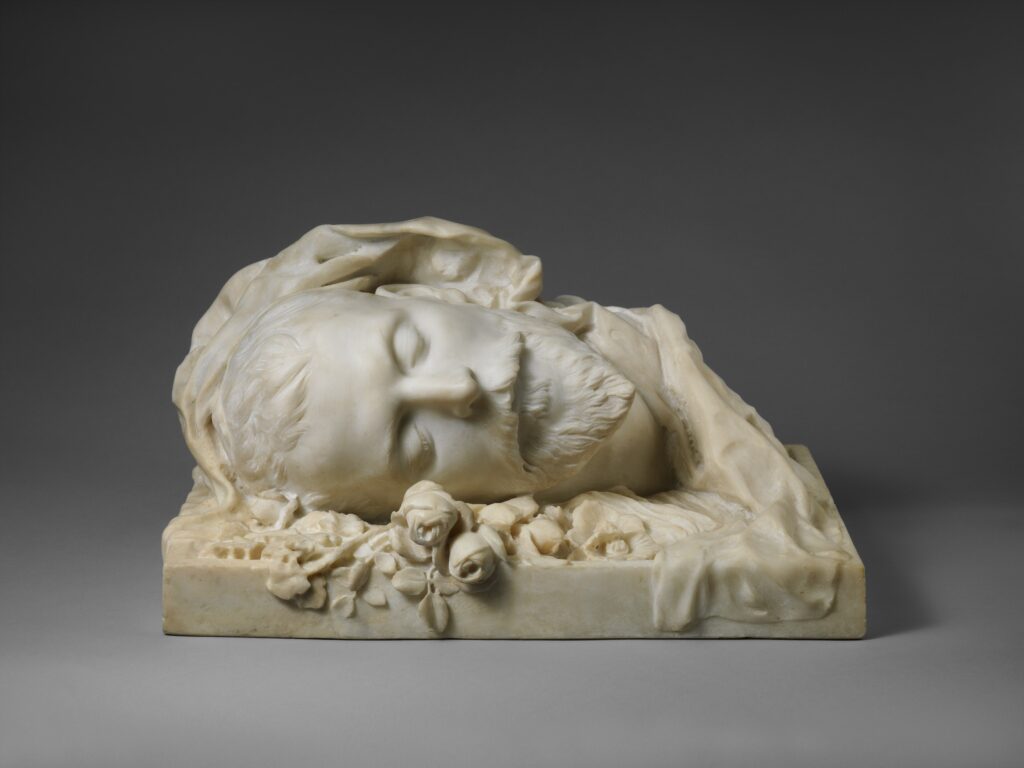
What often escapes historical notice is that the great tragedienne was also a gifted sculptor. She carved a memorial to her husband, the actor Jacques Damala (1855–1889), shortly after he had died of a drug overdose.
Beyond her artistic legacy, Bernhardt’s visits left behind a trail of vivid anecdotes:
During her 1882 visit, crowds followed her everywhere. In Lisbon, it was reported that Brazilian students tried to unhitch the horses from her carriage so they could pull it themselves; a common idol worship of the era.
Despite publicly praising the “noble Portuguese nation”, the business-minded Sarah Bernhardt privately complained about its humid theatres and travel logistics. However, she greatly appreciated the financial success of her tours, with tickets selling for triple the usual price.
If you are tracing her steps in Portugal today, these are the primary locations associated with Sarah Bernhardt’s visits:
• Teatro Nacional de São Carlos (Lisbon): where she performed her most operatic and dramatic roles.
• Teatro do Ginásio (Lisbon): the site of her 1882 Portuguese debut.
• Teatro D. Amélia (now Teatro São Luiz): where a commemorative plaque was placed in 1899 to honour her.
• Palácio do Rato: the residence of the Duchess of Palmela, where the elite gathered to dine with her.
Insert:
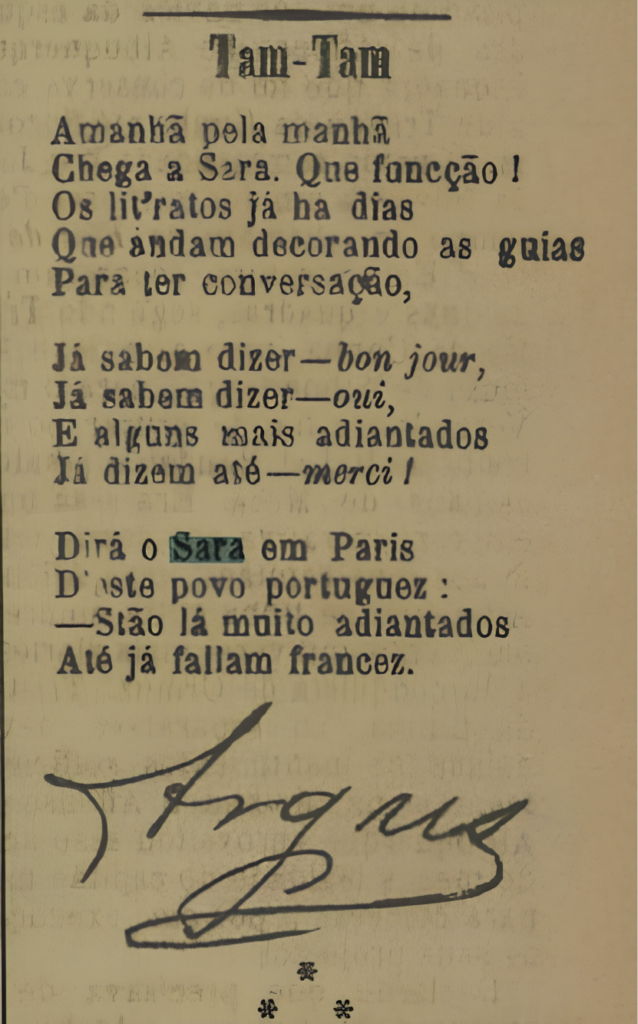
1888, April: Diário de Notícias was featuring a section on the front or second page where “Argus” (an established trademark of António de Castilho) would comment on the city’s social scandals, theatre openings and high-society gossip in a witty, rhythmic style. The poem mocks the lit’ratos (the pseudo-intellectuals) who were literally memorising French phrasebooks. At the time, French was the language of the elite, and Castilho was pointing out that their “sophistication” was entirely superficial; they were celebrating an actress they could barely understand.
Word-of-Mouth (Tam-Tam)
Tomorrow morning
Sara arrives. What an occasion!
For days now, the “men of letters”
Have been poring over the phrasebooks,
Eager to strike up a conversation.
They already know how to say — bonjour,
They already know how to say — oui,
And the more accomplished among them
Even venture a bold — merci!
Sara will surely say, once in Paris,
Of these Portuguese folk:
“They are remarkably advanced —
Even speaking French already.”