

Once upon a time, before plastic conquered the world, the people of Portugal relied on the land for the things they needed. If they wanted to shop at the market, strap the bountiful baskets to their donkey, store their food once home, or even sweep up afterwards, they simply went outside and gathered what was growing wild on the hillsides and along the riverbanks around them.
From these humble local plants came objects that were practical yet quietly beautiful. These hand and sun-made creations were, unlike plastic, fully biodegradable – and yet, remarkably durable. Indeed, the artisan I want to introduce you to this month learned his craft from his grandmother, and, although she has been gone for many years, he still keeps the pieces she made in his home.

Crafty Algarvian flora
I met Isidoro Ramos at the Palácio Gama Lobo, the headquarters of Loulé Criativo – a cultural initiative committed to preserving and promoting the region’s traditional arts – where Isidoro is one of their wonderfully creative resident artists.
Isidoro is a friendly and charming man, and I was eager to learn about his life and how he’s helping ensure these ancient crafts, preserved in the fingers of fewer and fewer artisans, don’t slip away.
But first, a bit of context. The Algarve is home to several native plants that can be transformed, with the right pair of hands, into some pretty practical things. There are too many to name here. But the Algarve classics, so to speak, are: palma (Chamaerops humilis, the dwarf palm) and cana algarvia (Arundo donax, the bamboo-esque reed). Palma is soft and wonderful for decorative baskets, while cana algarvia is tougher on the hands and perfect for sturdy, breathable baskets – the kind you hang from a tree with your picnic inside.
And then there’s the plant Isidoro works with, which more than deserves its place among the Algarve’s top crafty flora. Esparto (Stipa tenacissima) grows abundantly in southern Spain, but in Portugal it is found only in the Algarve and Alentejo. This remarkable grass thrives on hot, dry, rocky hills and, like its preferred environment, is tough – perfect for making the most long-lasting, hardwearing objects of the bunch.

Meet the artist
Isidoro was born and raised in Paderne. His grandmother taught him to weave esparto, making baskets and all sorts of items she would sell outside missa – the Sunday church service. His mother also made pieces, though only for family use.
He worked for a phone company until retiring four years ago. Half joking, half serious, he told me he doesn’t want much to do with phones anymore. “By the end,” he said, “the phone was a tool I needed for everything.” These days, he prefers not to get tangled up in technology but instead to sit with the radio on, weaving.
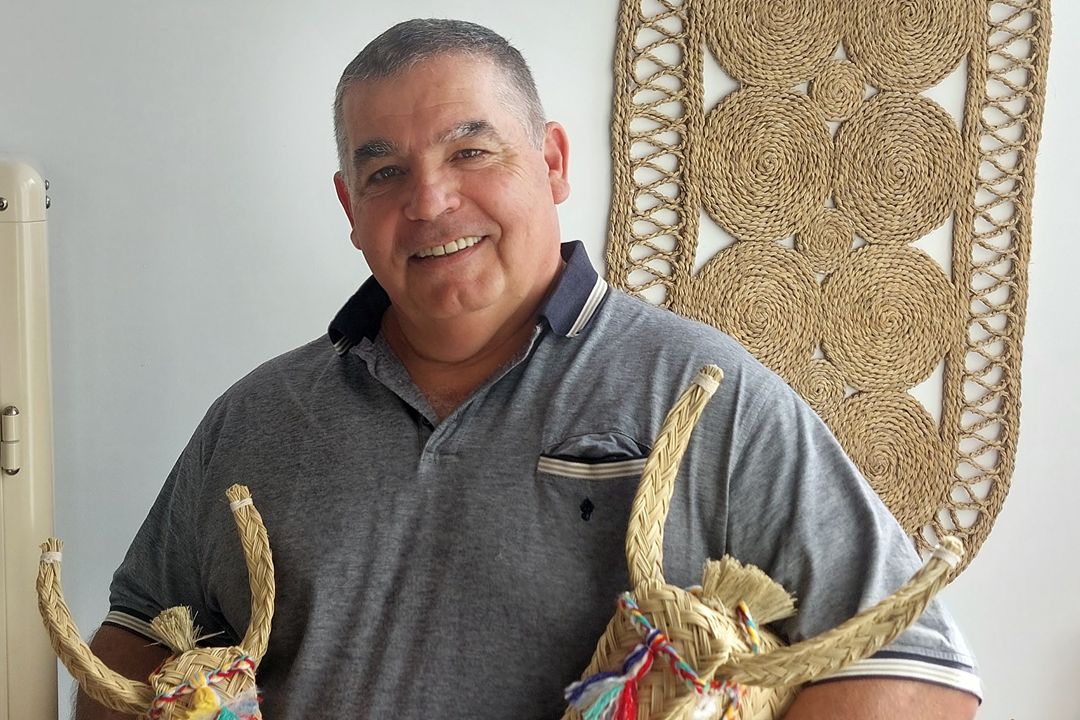
Standing in the Loulé Criativo shop, he showed me some of his work: broomsticks and brushes, traditional sturdy baskets ideal for carrying wood, beautiful horse heads, and even some less traditional mates – a lizard and a couple of tortoises.


The golden harvest
All these pieces take time – and even the harvesting is quite the job. Esparto is picked between July and September. But the process could be said to begin even earlier: in April and May, it’s a good time to go for a walk in the countryside as the esparto flowers. Isidoro joked that it almost raises a hand and waves at you – reminding you where to find it when the time comes.
Harvesting takes real oomph, as esparto must be pulled out, not cut. Afterwards, it is dried in the sunshine. If it’s kept in direct sunlight for two to three weeks, it stays golden and if it’s dried in the shade, it keeps a greener colour. Then it’s stored and soaked when he’s ready to use it, making it pliable again.
Isidoro likes to do a bit of this and a bit of that, not doing or making the same thing all the time, as the material can be tough on the hands. He had to make an exception recently when he received an order for fifty miniature horse heads to perch on top of wine bottles for a hamper company. Apparently, it was a lot of work. Very cute, though.
The grass weaves on
Isidoro’s plant has taken him on all sorts of adventures – from being part of Loulé Criativo to teaching adults at the Centro Educativo do Cerro do Ouro in Paderne. Schools often visit so children can experience and try these crafts firsthand.
Having learned these skills from an early age, Isidoro is passionate about preserving them. But he admits that workshops can be challenging: esparto is a demanding material, and it’s difficult to teach beginners to complete something in just a few hours. But with time and patience, he enjoys weaving this ancient art into new hands.
Instagram: @coisasdoesparto