
As St Valentine’s Day approaches, Portugal leans into its most cherished tales of devotion. Stories which have been told through centuries, echoing the longing and loyalty found in the greatest love story of them all, Romeo and Juliet. Across the country, legends tell of lovers separated by rivalry, tradition or fate, yet bound by a determination that feels unmistakably Portuguese.
These are not just tragic romances; they are reminders that love, even when tested by bitterness or conflict, has a way of rising above hate. To celebrate the month of love, let’s take a look at some of Portugal’s tales of love.

The Girl with Seven Skirts
Nazaré, long shaped by its seafaring heritage, holds a legend that binds land to sea and echoes through many Fado songs. It tells of a young woman who waited each day on the cliffs for her fisherman lover to return safely home. She was said to wear seven colourful skirts, a garment both practical and symbolic: the inner layers kept her warm against the Atlantic winds, while the outer skirts caught the breeze like bright flags, guiding sailors toward the shore like a living lighthouse.
Each day, she stood on the cliffs, her skirts fluttering wildly as a signal of hope. What she did not know was that her beloved had been lost far out at sea, battling a violent storm in the darkness of night. From the moonlit horizon, he eventually glimpsed the familiar colours of her skirts whipping in the blustering wind. Through the chaos, he steered toward his love, reaching the shore alive.
Guided home by the girl’s courage and devotion, the couple married and made a family together. Though their names have been lost to time, the girl’s story lives on through the women of Nazaré, who continue the tradition of wearing the seven-layered skirts as part of the area’s traditional costume. It has become a lasting symbol of steadfast love, protection, and the unbreakable bond between those on land and those at sea.

Saved by a Stone
Closer to home in Portimão, local legend tells that in the final years of the Moorish presence in Portugal, when crusading forces were steadily reclaiming territory from Arabian rule, the daughter of the last Moorish king of Silves fell deeply in love with a Christian knight. Their devotion was fierce and unshakable, defying the boundaries of faith, allegiance and kingdom.
When the king uncovered their secret, he ordered his soldiers to seize the princess and confine her in the highest tower of the old stone castle in Portimão. But the knight, aided by loyal companions, stormed the fortress and freed her. They fled together into the night, carrying a small bag of treasure.
Enraged, the king dispatched his guards to pursue the couple and bring them back to face punishment for treason. Realising they were being hunted, the princess and her knight asked one of the crusaders, who was also a priest, to marry them at once. Soon after, they spotted a cave and took refuge within it.
As they hid, a great stone is said to have rolled down from the mountains of the Serra de Monchique, sealing the cave’s entrance and concealing them from the king’s men. For several days, they remained hidden until the stone slowly sank into the earth, releasing them once more to freedom.
Today, that same rock still stands, now surrounded by modern buildings on the aptly named Rua da Pedra. But if legend is to be believed, the lost treasure still lies buried beneath the great boulder at the side of the road, which locals call Pedra Mourinha.
From Death Do Us Part
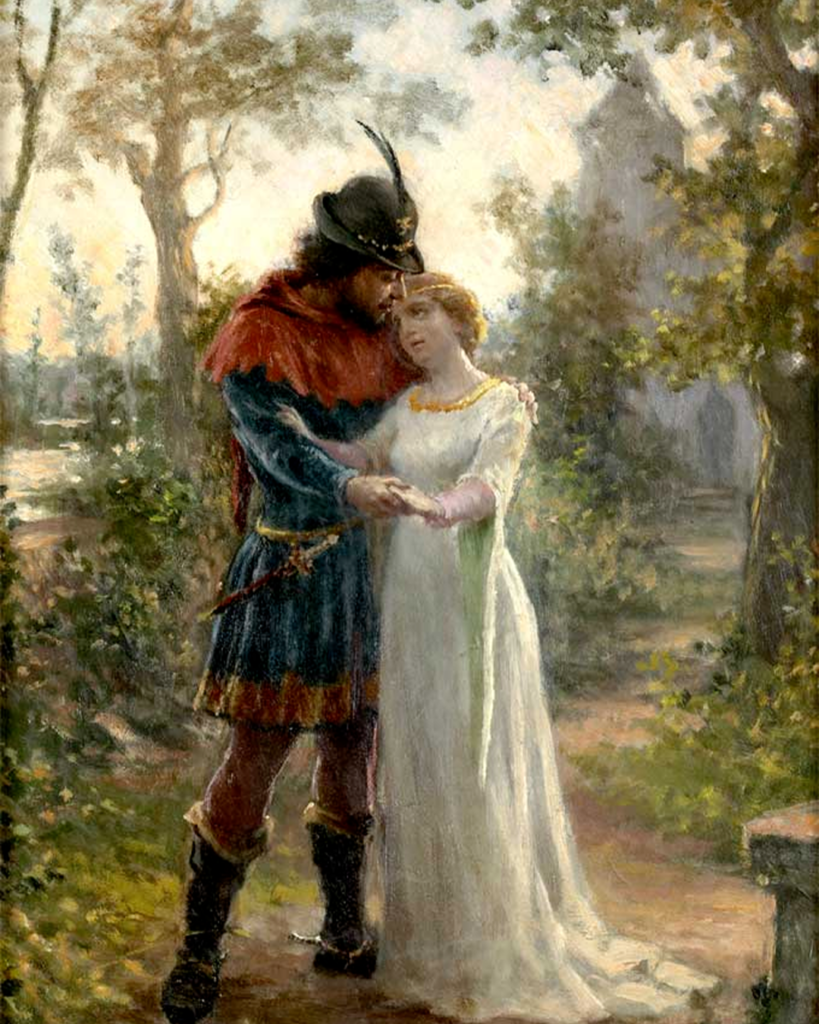
The 14th-century story of Prince Pedro and Inês de Castro bears a slight resemblance to the unconventional marriage of Britain’s King Edward VIII and Wallis Simpson, although at least they were able to live out their romance in exile.
According to legend, Pedro, son of King Afonso IV, fell deeply in love with a Galician noblewoman named Inês de Castro. The only problem was that Inês was the lady-in-waiting to his wife, Constanza of Castile. The two reportedly experienced love at first sight, causing a scandalous, open affair that strained his political marriage. Inês was from a powerful Galician family and the court feared their influence over the Portuguese crown.
Defying his father’s order to end the relationship, Pedro refused to abandon the woman he considered his one true love. Following Constanza’s death in 1345 the couple settled in Coimbra, where they had four children and lived openly as a family, in direct defiance of royal command.
Around 1355, while Pedro was away, King Afonso IV sent three guards to “resolve the situation” Inês de Castro was beheaded at the family estate at Quinta das Lágrimas, with her young children nearby, without trial and without Pedro’s knowledge.
When Pedro learned of the murder, he vowed that once he ascended the throne, he would hunt down the killers and bring them to justice. Two years later, following Afonso IV’s death, Pedro became king. At his coronation, he declared that the ceremony was also the coronation of his dead queen. He ordered Inês’ body to be exhumed and forced the court to kneel and kiss her hand in recognition of her status. Pedro I claimed that he and Inês had secretly married before her death, making her queen consort in death if not in life.
True to his word, Pedro I pursued the three assassins: Pêro Coelho, Álvaro Gonçalves and Diogo Lopes Pacheco. Pêro and Álvaro were captured and executed in a manner mirroring Inês’ own death. The third, Diogo Lopes Pacheco, escaped to Castile and survived. Though Pedro was never able to bring him back to Portugal for trial, he never forgave him and permanently forbade his return – a final act of devotion in memory of the woman he loved and lost.
Alentejo’s Romeo and Juliet
The wide, open fields of Alentejo might not seem the natural backdrop for a Romeo and Juliet-style tale, yet this 20th-century legend carries all the love and heartbreak of Shakespeare’s most famous tragedy.
In the town of Alcácer do Sal lived a bachelor named Luís Inácio de Paiva, a wealthy landowner and property magnet. He fell in love with a young woman, Laura Branco, whose background and social standing differed greatly from his own. Despite the differences between their social status, their affection only deepened, quietly dismantling the barriers that tradition had set between them. Laura, though born into a respected household, did not have the influence or status expected of a match for a man of Luís’s rank. With both families arranging more ‘suitable’ futures for them, it seemed the pair were destined to be kept apart.
Refusing to accept such a fate, the two Alentejo lovers chose a path that echoed the sorrow of Shakespeare’s star-crossed pair.
According to local belief, in 1912, Luís Inácio de Paiva and Laura Branco chose to die together, hoping to remain united in death since life had denied them that right. Rejected by both their families, they are said to have first attempted to end their suffering with poison. When that failed, and overwhelmed by despair, they sealed their tragic fate with two fatal gunshots to the heart, leaving their story to be dubbed “Alentejo’s Romeo and Juliette”.

A Viral Engagement
But love stories are not just a thing of the past! Arguably, the biggest romantic drama that Portugal witnessed in the past year is the engagement of football legend Cristiano Ronaldo and his fiancée, Georgina Rodríguez. The couple announced their engagement on social media in August 2025 with a photo of Georgina’s spectacular ring that went viral.
Having first met in a Gucci store in Madrid back in 2016, the pair have finally decided to tie the knot in true style. The museum-worthy, oval-cut diamond ring is reported to be valued at up to US $13 million, making it one of the most expensive engagement rings in the world.
Although details remain scarce, it is widely believed that the wedding will take place on the island of Madeira this summer, following the 2026 FIFA World Cup, in what is expected to be a star-studded and exceptionally luxurious celebration.