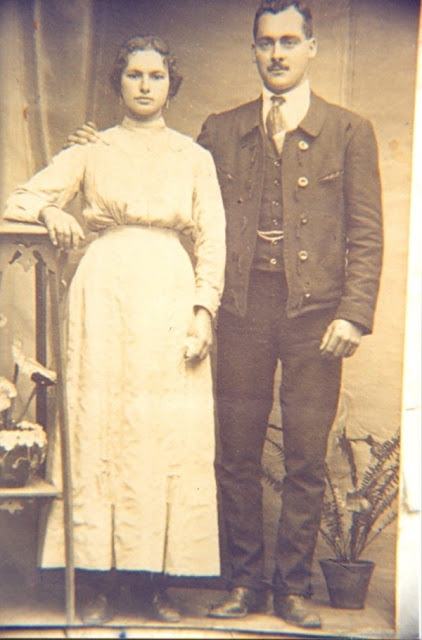
Grandmother Josefa and Mother Maria da Piedade: José Saramago’s Roots of Greatness
(Words & translations: Dan Costinas)
(Photo: Courtesy of Fundação José Saramago – Arquivo)
In this series, Dan Costinas investigates the women who have directly influenced Portuguese history or the arts. This month, he explores the influence of Maria da Piedade, whose son was José Saramago (1922–2010), a world-renowned Portuguese novelist, journalist, and playwright who won the 1998 Nobel Prize in Literature.
On a crisp December day in Stockholm in 1998, José Saramago stood before the Swedish Academy to deliver his Nobel acceptance speech: How Characters Became the Masters and the Author Their Apprentice. He began not with a grand treatise on the novel, nor with a homage to the titans of European letters, but with an invocation of the unlettered wisdom: his maternal grandparents, Jerónimo and Josefa, landless swineherds who could neither read nor write. Yet running just beneath the surface of his famous homage was another figure of quiet, foundational gravity: his mother, Maria da Piedade.
The anchor and the myth-maker
If young José’s grandfather was the myth-maker who ‘could set the universe in motion just with a couple of words’, his mother was the unyielding anchor that kept her son tied to the earth. In the quiet, cramped spaces of their Lisbon home, she served as the boy’s first critic – not of his writing, but of his imagination. Whenever the future writer was shaken by night terrors spawned by his grandfather’s vivid fables, it was Maria who restored order with sharp, peasant pragmatism.
As Saramago recalled decades later:
Se eu lhe contava algum mau sonho nascido das histórias do avô, ela sempre me tranquilizava: ‘Não faças caso, em sonhos não há firmeza’. (Whenever I told her about a bad dream born of my grandfather’s stories, she would always reassure me: ‘Don’t worry about it; dreams aren’t to be taken seriously.’)
Where Jerónimo offered the allure of fantasy, Maria offered the grounding of truth. This tension between dream and reality became the very engine of Saramago’s literary style: a world of surreal allegories. In As Intermitências da Morte (Death with Interruptions), the central premise – where death goes on strike and people stop dying in an unnamed country – serves as a multi-layered allegory about human existence, societal structures, and mortality. But they are always met with the stubborn, practical endurance of ordinary people.

Dignity in the frame
Maria’s influence was not merely philosophical; it was intensely visual. In his childhood memoir As Pequenas Memórias (Small Memories), Saramago looks past the exhaustion of her daily labour as a domestic cleaner to remember her dignity, writing simply:
‘My mother was a beauty. It is not me who says so, but the photo.’
Looking back at an old photograph of her leaning against a tall pillar with a flower in hand, he noted in his Nobel address that he felt compelled to record her image to understand his own composition:
‘I wrote these words almost thirty years ago, having no other purpose than to rebuild and register instances of the lives of those people who engendered and were closest to my being, thinking that nothing else would need explaining for people to know where I came from and what materials I was made of.’
His mother understood the terrifying stakes of raising a child in poverty. Later in life, Saramago reflected that “Being a father or mother is the greatest act of courage that one can have, because it is exposed to all types of pain, mainly in the uncertainty of acting correctly.” Through her quiet bravery and uncompromising clarity, Maria da Piedade gave her son his most crucial artistic gift: the realisation that before a writer can soar into the realm of myth, they must first understand the solid, unvarnished weight of the earth.
The books she couldn’t read
Beyond her practical sacrifices, Maria da Piedade left an indelible imprint on Saramago’s portrayal of women. In his major works, female characters like Blimunda in Baltasar and Blimunda, and the doctor’s wife in Blindness, serve as the moral backbones of their communities. They possess a steadfast resilience and poise under pressure that mirrors what Saramago witnessed in his mother.
This intimate upbringing provided the bedrock for his self-directed literary path. By grounding his education in his family’s lived hardship, Saramago forged a style in which formal prose was forever elevated by the raw dignity of working-class speech.
Her legacy was not merely the memory of maternal devotion, but the gift of a rigorous social conscience and an enduring belief in the transformative power of the written word.