The 500-year story on your café counter.
As a teenager, cinnamon was a status symbol – one I had invented entirely in my own head. I would steal a stick from my mum’s spice box, tuck it into the corner of my mouth and inhale through the natural hollow in the bark, pretending to be a character straight out of The Godfather. A wannabe gangster always needs a cigar, and this was as close as I was going to get at that age.
Now, as an adult with an insatiable interest in cooking, health and natural wellness, cinnamon plays a very different role in my life and is a spice I became quietly addicted to, largely because of its healing properties.
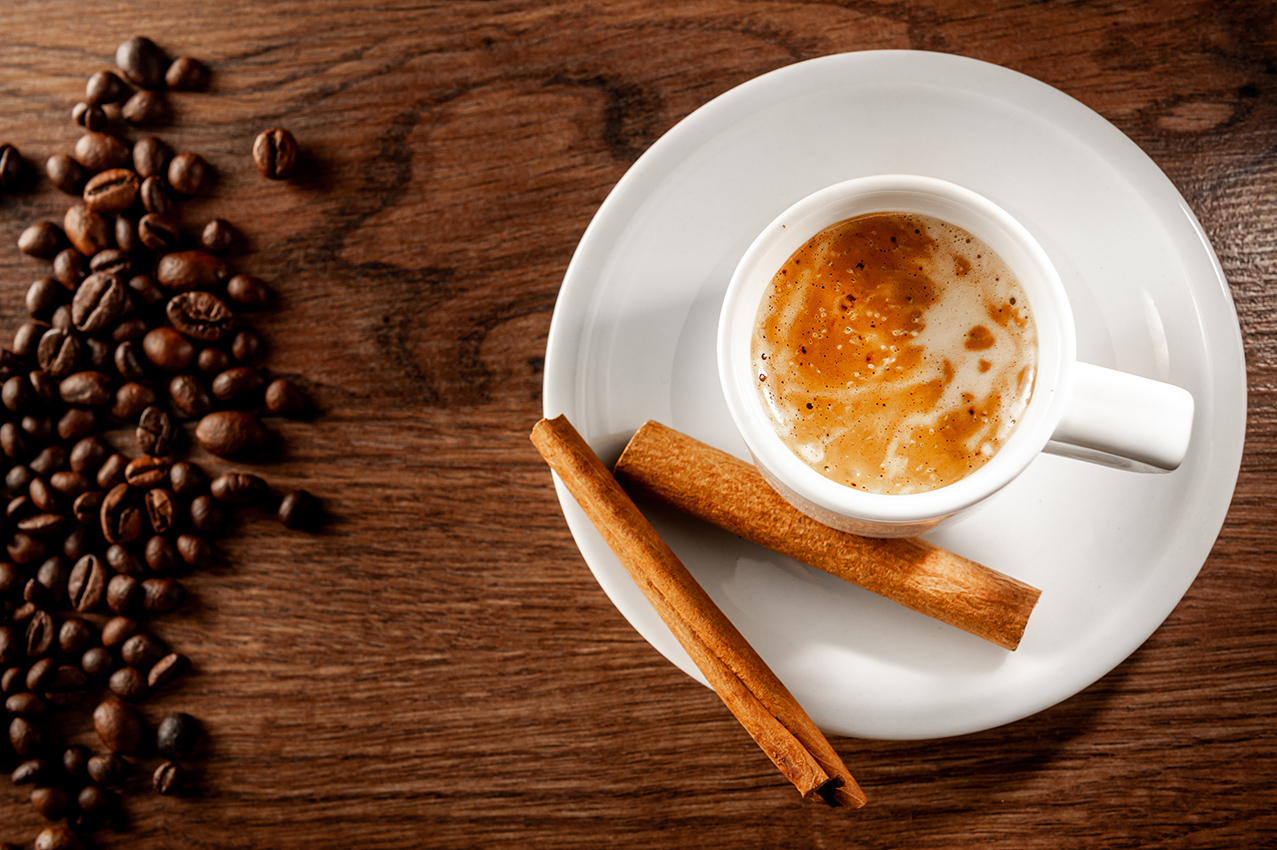
Since arriving in Portugal over 17 years ago, I was surprised to find a cinnamon shaker on almost every café counter. I never paid much attention to its significance until I became interested in functional medicine and realised how important it was for balancing blood sugar. That’s when I grew curious about the history of its arrival in Portugal, and how and why it became so woven into the culture.
The cinnamon story
The cinnamon story begins around 1505, when Lourenço de Almeida, a Portuguese explorer, reached the shores of an island then known as Ceylon, which is present-day Sri Lanka.
What he found there was the source of what traders called Cinnamomum verum, or “true cinnamon”, the name coming from the Latin word verum, simply meaning true. This was the original cinnamon, native to Ceylon, with a delicate, sweet flavour quite unlike the stronger, spicier cassia varieties that most of the world uses today.
At the time, cinnamon was a significant status symbol in Europe, prized as a preservative, a medicine, and a luxury of the wealthy. Before the Portuguese arrived, the trade had been controlled by a chain of Arab and Venetian middlemen, who kept the spice’s origin a closely guarded secret. The Portuguese quickly grasped what they had found and moved to secure the trade. By 1518, they had built a fort in Colombo and established dominance over the cinnamon supply that would last for roughly 150 years, until the Dutch displaced them in 1658. During their reign, the Portuguese had been fiercely protective of what they called the “golden bark”, so much so that the destruction of a cinnamon tree was reportedly made a crime punishable by death.
Unlike black pepper, cinnamon was delicate and had to be handled with care to preserve its natural oils. The logistics of transporting it to Europe were considerable. Great armadas sailed around the Cape of Good Hope, their hulls packed with carefully stowed quills of bark. When these ships finally entered the Tagus and docked in Lisbon, the city became, for a time, the spice capital of the world.
From the warehouses of the Casa da Índia, housed in the royal Ribeira Palace on what is today Lisbon’s Praça do Comércio, right on the banks of the Tagus, cinnamon flowed out across Europe. As a result, the spice shifted from being viewed as a rare medicine to a staple of royal courts in France, England and beyond, quietly transforming the way an entire continent cooked.
The most enduring result of this era for Portugal may be the Pastel de Nata. While traders managed the global spice market, the monks of Lisbon were busy in their kitchens. Legend has it that the monks at the Jerónimos Monastery in Belém used egg whites to starch their habits, leaving them with a surplus of yolks, which inspired them to begin baking rich, custardy tarts. The monastery sat close to the harbour where the spice ships docked, giving the monks easy access to sugar and cinnamon. Today, eating a Pastel de Nata without a dusting of cinnamon is almost unheard of in Portugal.
The health benefits
What may have begun as simple intuition has since been confirmed by modern science. Cinnamon is well-documented for its role in moderating blood sugar responses, and it is exceptionally high in antioxidant polyphenol compounds that help neutralise free radicals in the body, and which consistently place cinnamon among the highest-ranking spices for antioxidant activity. A 2017 study published by the Egas Moniz School of Health & Science, located across the river from Lisbon in Monte de Caparica, specifically examined this tradition. Researchers found that adding around three grams of cinnamon to a Pastel de Nata helped reduce the blood sugar spike that typically follows a sweet pastry, while also contributing those same beneficial antioxidant compounds. Whether the monks knew this or simply liked the taste, the combination turns out to be quietly functional, a way of softening the sugar hit of something delicious.
I still chew a cinnamon stick sometimes, now I’m rather more deliberately trying to manage my blood sugar after working my way through the Portuguese pastry selection, instead of pretending to be a mafia Don.
The nostalgia from those childhood antics is still alive in my memory, and it strikes me that it’s probably not so different from what many locals feel. For them, cinnamon has likely been present since the day they were born, woven into the smell of their grandparents’ kitchens, the taste of a pudding, the ritual of a morning coffee. The Portuguese palate is so accustomed to cinnamon that it appears in everything from arroz doce to savoury stews.
A 500-year-old story, still alive on café counters up and down the country. Isn’t it funny how you take so many familiar little things for granted, and then when you become curious about them, they almost inevitably turn out to have come from a much bigger story than you could ever have imagined.