If there’s one thing I allow myself to be strongly opinionated about, it’s art. Having been formally educated at university level, I was drilled to unlearn, to see with a child’s eyes, to conceptualise without the boundaries of technology, and to let my mind roam freely.
Yet unknowingly, as happens to so many who pursue formal education, I was being boxed into the particular methodology of my course. I became, like many others, a product of learned behaviours that didn’t truly allow for pure self-expression – every concept had to be justified.
Nearly thirty years after graduating, I’ve found myself inspired by an artist who has never had any formal art education. Karina Lyra is entirely self-taught and left school at sixteen because she didn’t believe it was adding anything meaningful to her life. In the last four years, her skills have been developed through learning from YouTube videos and experimenting. That’s it.
On my way to meet her, I navigate the familiar narrow cobbled streets toward the atelier, located just beside Bar Elephant, an eccentric spot that holds fond memories from when I lived in Monchique. The atelier sits just above it.
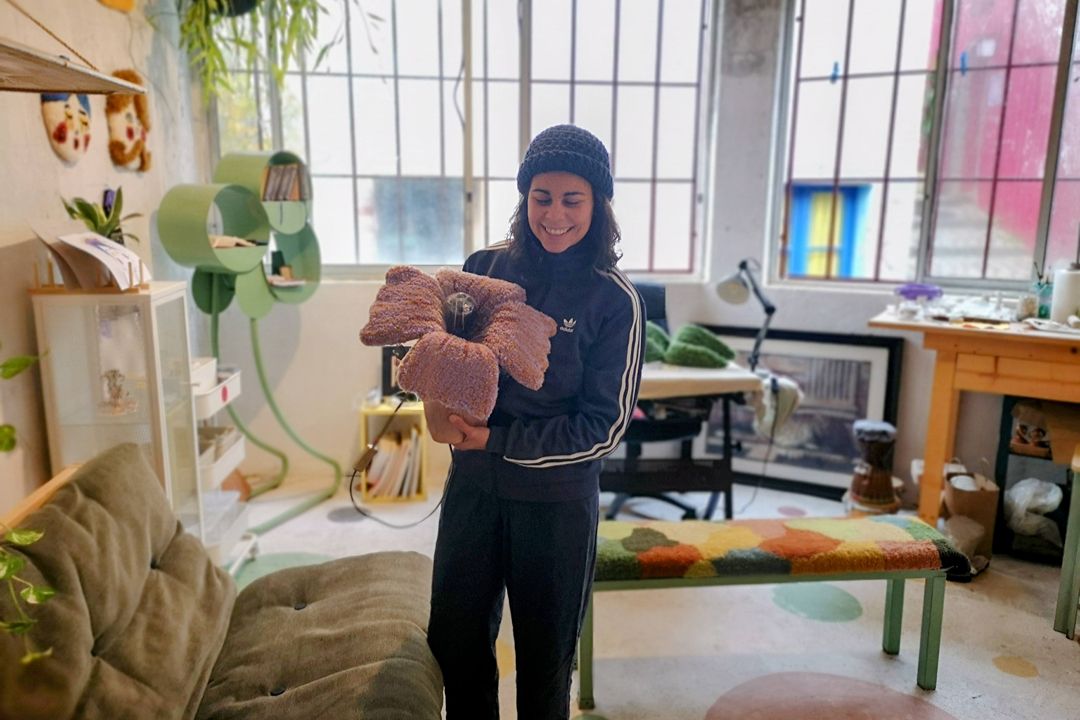
As the metal doors open and our eyes meet, I feel an instant connection. There’s a sparkle in her eyes that brings much-needed warmth to this chilly, wet and dreary day. I immediately feel happy in her presence, filled with a childlike excitement to finally see her art in person.
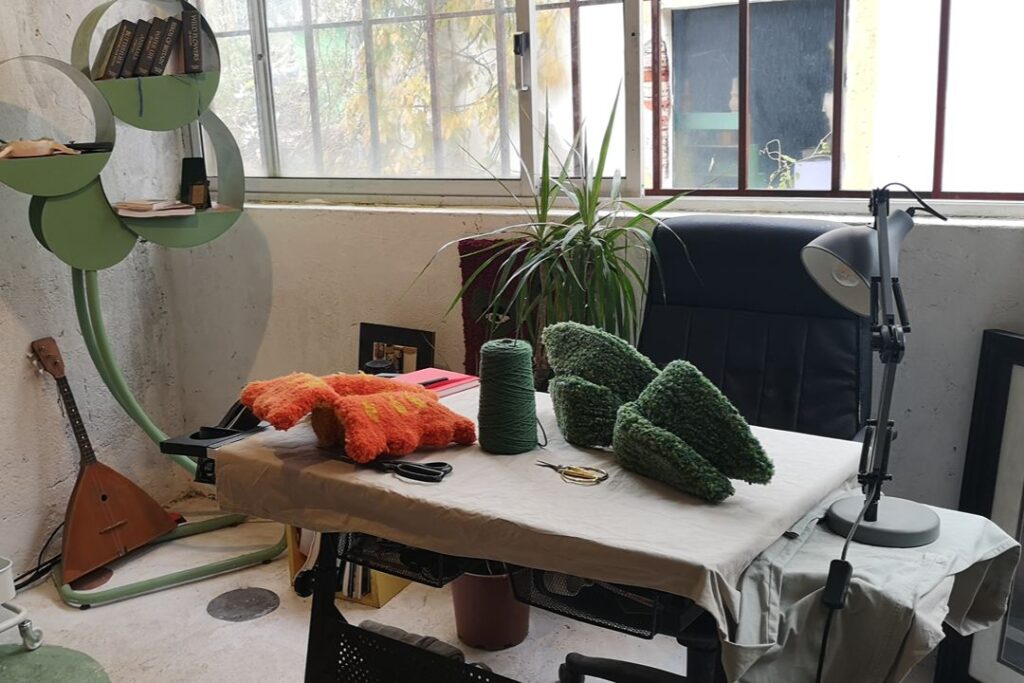
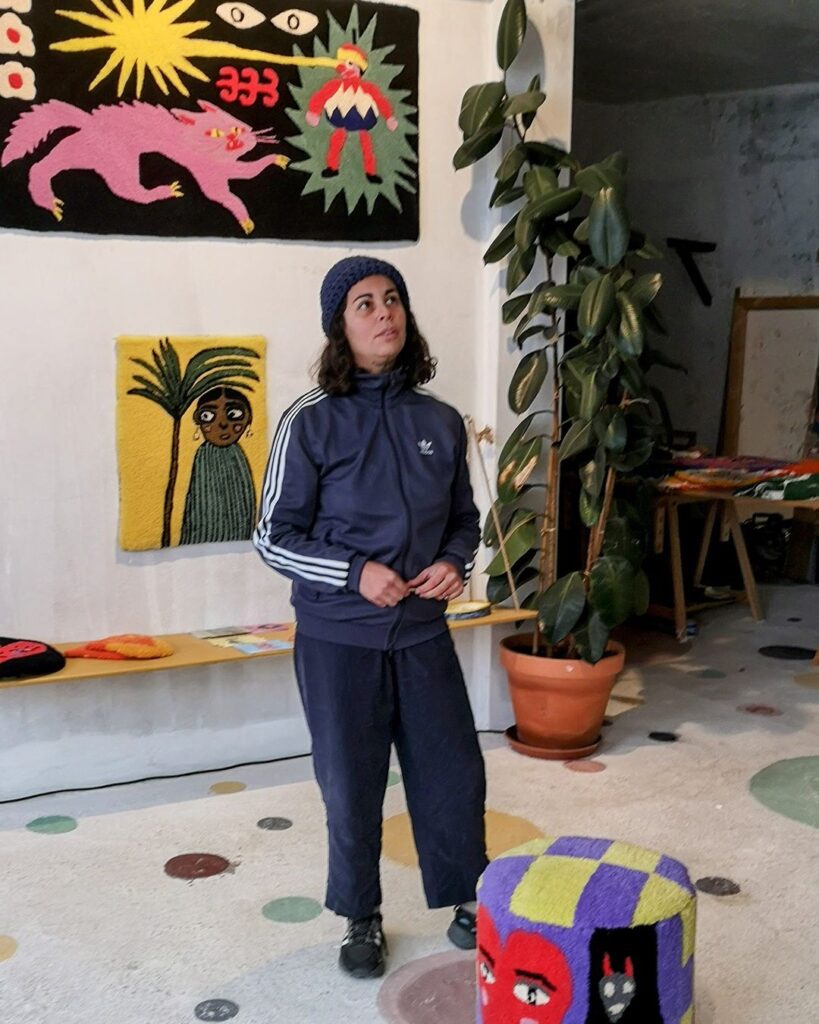
The studio is freezing, but the bright colours and wool make it seem surprisingly cosy. It reminds me of a mini version of LAC in Lagos, but this space has a more optimistic, vibrant and younger ambience. There is a brutal honesty about it, no pretence at all. It is raw, unfinished and a work in progress. Karina explains how much work has already been done to turn this from an abandoned old supermarket.
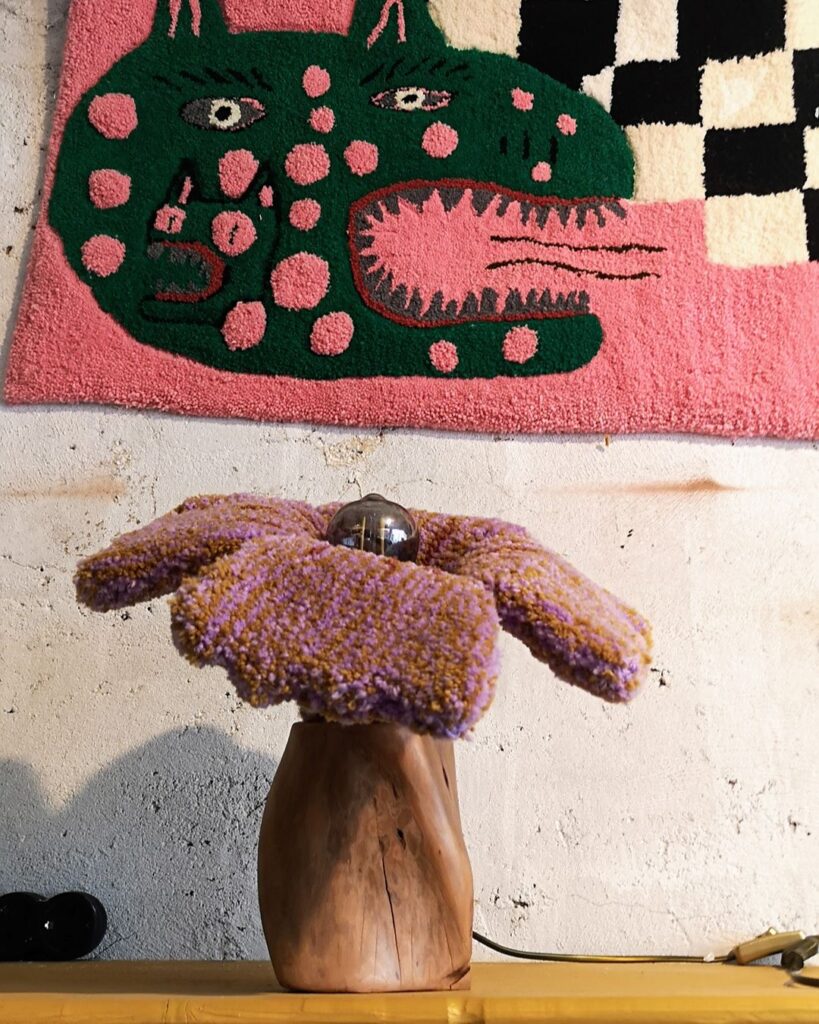
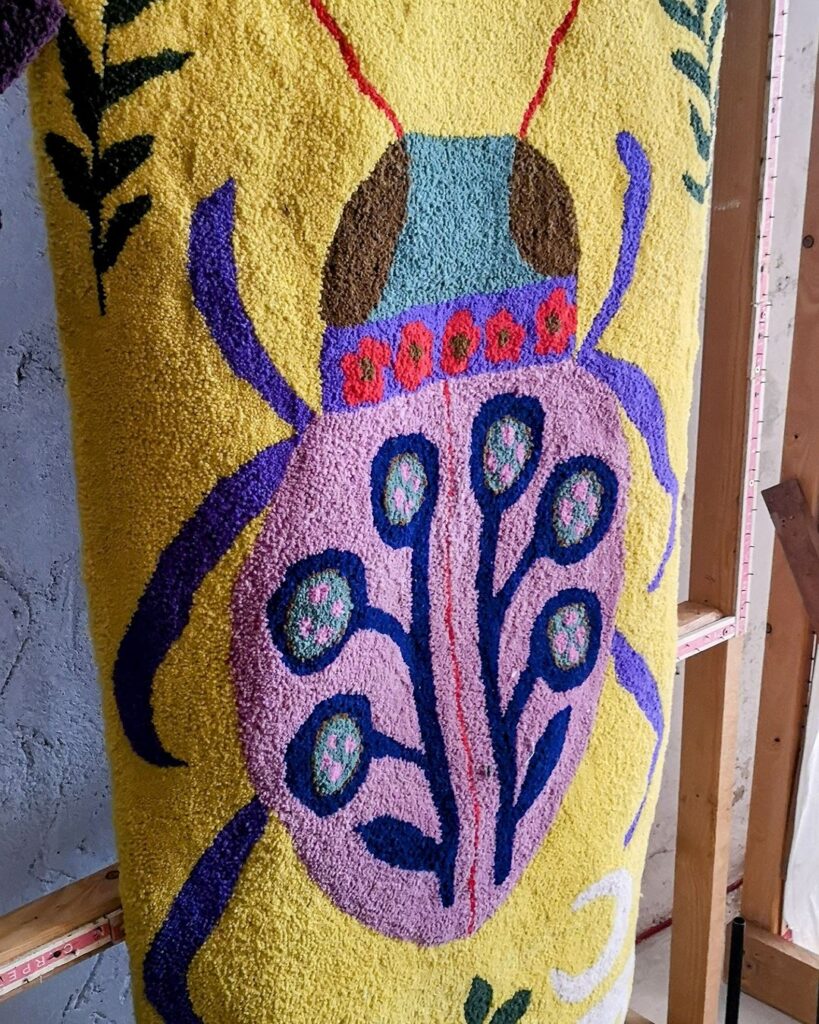
Her work has a Cubist quality, especially in its early days, when African art had a strong influence. But her art is bolder, with brighter colours and a strong botanical influence.
I learn later that her roots are Brazilian – this may explain the indigenous influence in most of her art.
Her pieces are literally full of fluff, crafted from Portuguese wool and sometimes New Zealand wool, using a technique called tufting. Each piece has a carpet-like feel, making it homely, comfortable and familiar. Yet despite this soft, tactile quality, there is nothing fluffy about her approach or her artistic vision.
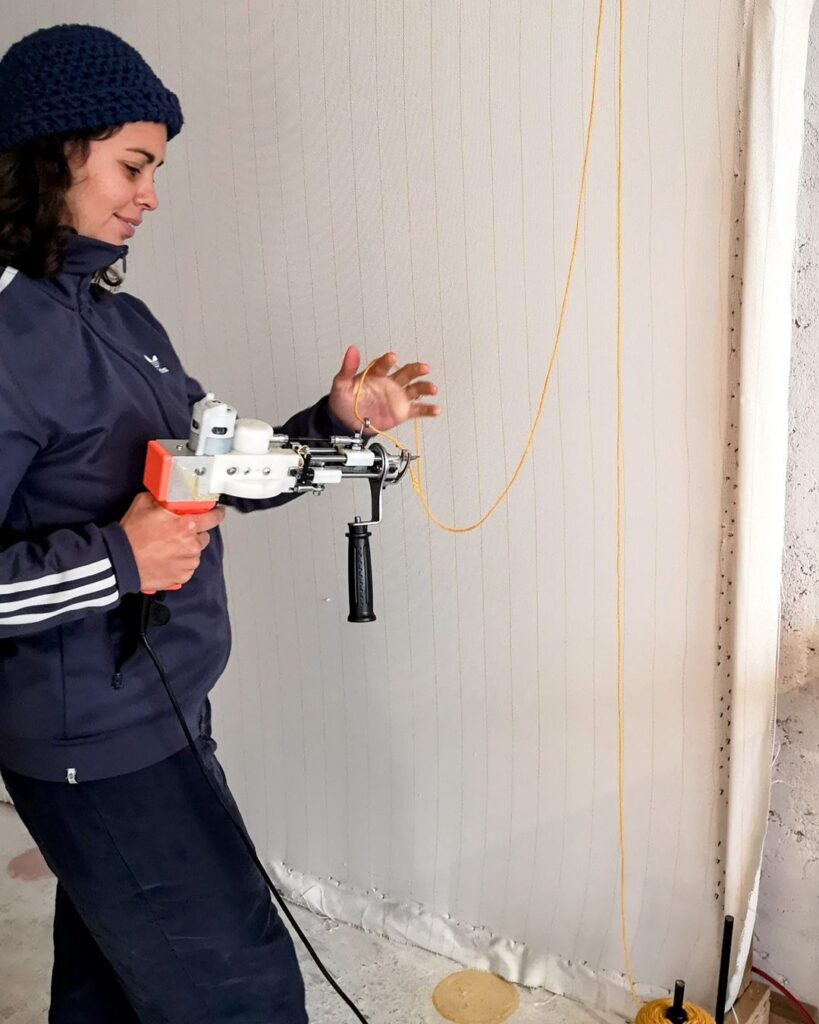
To craft these pieces, she wields a tufting gun – a modern textile technique where yarn is ‘shot’ or pushed through a stretched backing fabric to create patterns and textures. This machine resembles a mobile sewing machine used more like a builder’s hand drill against a wall, yet demands something far more visceral. It’s a tool you dance with, moving your entire body in rhythm as you punch threads of coloured wool through canvas, building shapes and patterns, stroke by deliberate stroke. Each piece is born from a delicate choreography of strength and precision. The gun is unforgiving; one wrong move and it can tear through the canvas, unravelling hours of work in an instant. It takes courage to commit to this medium.
Karina’s work is the pure expression of an artist who revels in the process itself, who feels no need to justify anything beyond the love she feels for what she creates and the joy it brings her. It’s playful and childlike, yet remarkably mature in its composition.
Some of her artwork is constructed into stools and lamps, where she uses local medronho wood, polishes it down and adds her flower-sculpted lampshades.
These are works you take as they come. If they resonate with you, if they bring you joy and a sense of playfulness, then that’s all she intended – nothing more, nothing less. To construct narratives around them would strip away the very purity that makes them so compelling, and this is exactly why I admire her work. Unlike my ‘taught’ approach, she presents no elaborate concept around her pieces. Yet I find myself subtly trying to get answers about the process, talking to her, almost like we are in therapy – we joke about this, as I make her cry when she mentions the support she feels from her partner and the father of her two young children. I can’t help but shed a little tear too, as her brutal honesty and soft energy get to me. I finally realise that the reassurance and support from him in expressing her creativity leave her with a strong sense of self-assurance and a lack of need to justify what she does. This truly sets her apart from the pretentious world that I was once surrounded by.
Born in Brazil, Karina’s family moved to Praia da Rocha when she was eight, where she finally felt free and safe – a stark contrast to the volatile early 1990s Brazil they’d left behind, where her mother had been robbed at gunpoint twice. After leaving school, she met Pablo through common friends in Lisbon, a German-Portuguese brought up in Monchique, where they eventually decided to have children young and make their home.
In the years between having their children, they spent time in Berlin and Leipzig, experiences that reconnected her with her forgotten Brazilian roots and exposed her to an inspiring art world. But she also experienced racism firsthand, and the cities felt wrong for raising a family. Monchique, with its fresh air, clean water, and surrounding nature, was the answer.
The atelier is more than just a studio: it’s an ambitious project. With permission on its way in February to create a cultural association within this space, there will be music lessons, the possibility of open-air cinemas on the reconstructed rooftop, and a space for any artist’s burning desires to be expressed in a safe and creative, shared space. The cultural association will attract so many more creative possibilities in Monchique. Oh, how I wish this existed when I lived there. Karina and I remember when we were bringing up our small children, nothing was happening in Monchique, and she says to me, “If you want something to happen here, you need to do it yourself” – something she has finally achieved.
If you’re a curator, gallery owner, art collector, or anyone with influence in the art world, pay attention: Karina Lyra is an artist you need to know. There’s a hidden brilliance to her, a humility that suggests she’s yet to be fully discovered. Her work remains largely undiscovered, waiting to bloom, and, like the flower lamps she creates, she beams with light, colour, and untapped potential that hasn’t yet found its spotlight.
I don’t often advocate for artists this way, but her work compels me to. There’s a rare authenticity here, a brilliance that deserves to be seen before the rest of the world catches on. Consider this your invitation to be among the first.
Instagram: @atelierdelyra