


On 4 November, the Lagos Museum was accredited with inclusion into the Portuguese Museum Network (RMP). The accreditation ceremony took place in Braga during the annual meeting of the RPM. This accolade is not only an honour but ensures policies and standards are adhered to in the portrayal of Portugal’s rich history.
The museum was founded in 1930 by José Formosinho with diverse, unique collections, including sacred art, oddities, Lagos history, archaeology, ethnography, and, its highlight, a temple that belonged to the Brotherhood of Santo António. It is truly a magnificent spectacle and was elevated to National Monument status in 1924.
Patricia Palma from the Divisions of Museum and Cultural Assets came to the reception area to meet and advise me on the best route to observe all the exhibits. The entrance foyer describes the founder as having been a student at the Military College in Lagos before becoming a distinguished archaeologist. An example of carved stonework in the Gothic style is exhibited here and the combined efforts of the archaeological excavations he organised and the constant donations he encouraged have resulted in this wonderful historical archive.


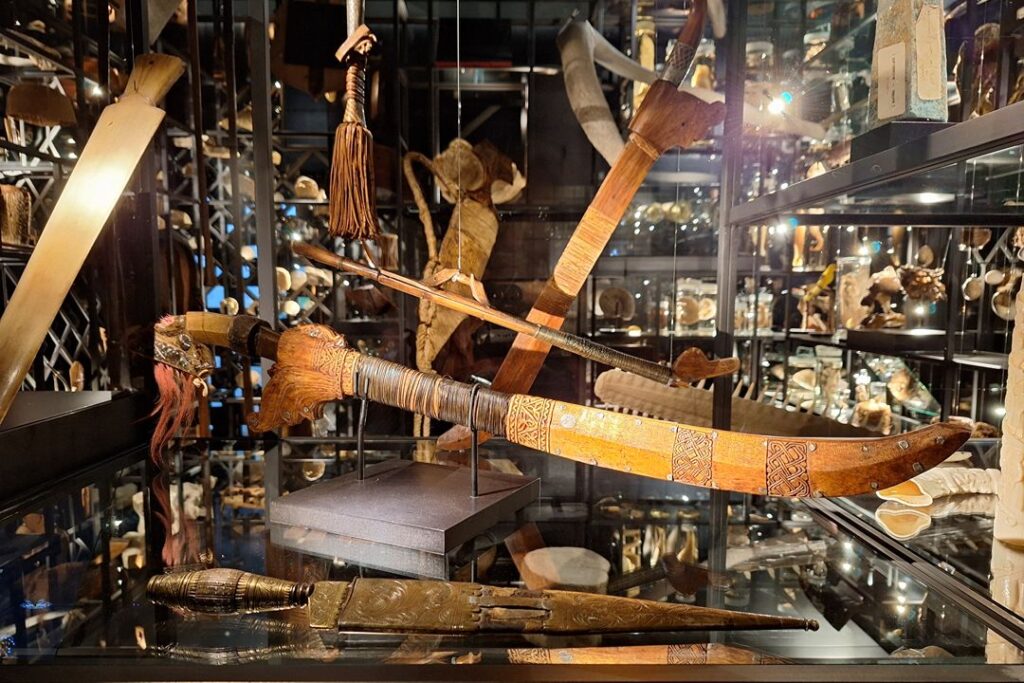
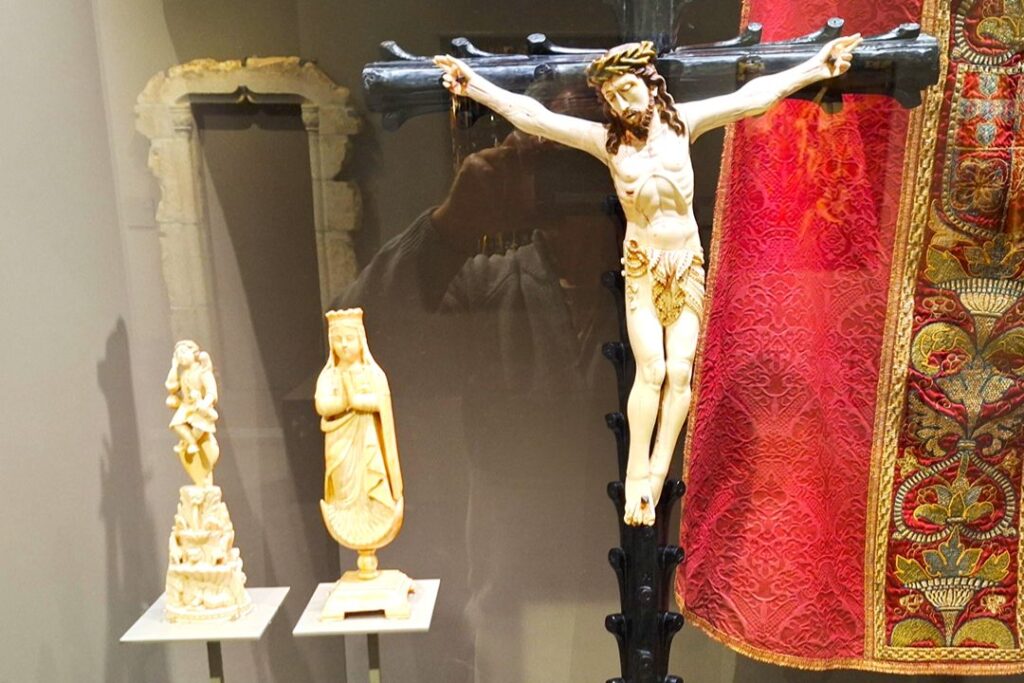
The museum is organised into 11 displays, each in its own room. The first room houses religious ivories and vestments from Christian Eastern communities like India and Sri Lanka, brought to Lagos by residents and traded for profit. Next, visitors will come to the Cabinet of Curiosities, a random assortment of interesting artefacts and oddities collected by the founder himself over a lifetime of dedication to the museum. Items as diverse as weapons of war to stuffed animal heads, and natural anomalies like an eight-legged goat to unusual undersea creatures bottled in preservation liquids.
A section on maritime activity – Defending the Kingdom at Land and at Sea – describes the Battle of Lagos, a naval campaign, when the British fleet defeated the French in 1759 off the coast of Praia da Salema and sank the French flagship L’Océan. It was all part of the Seven Years War. Artefacts, cannon and weapons of war are displayed here. In all the museum displays, the descriptions in both English and Portuguese are most helpful.
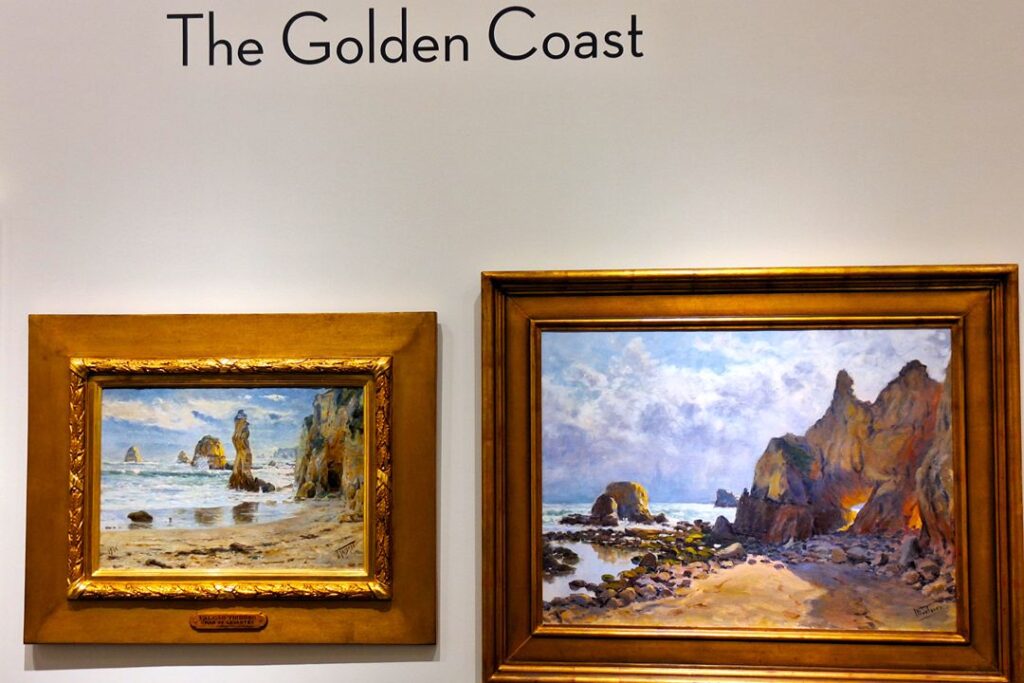
There are three rooms dedicated to art and theatre. Renowned actor Estevao Amarante (1892–1965) rose from a vaudeville entertainer to a serious actor and is here depicted in an oil-on-canvas portrait. Other pieces are paintings featuring life on land, life in an urban environment (Inside the City), and landscapes of coastal scenes described as ‘The Golden Coast’. There can be no denying that the Algarve has some of the most dramatic coastal scenery in Europe, with its caves, grottos and natural sculptures formed by the sea and the weather, eroding the soft yellow sandstone and limestone cliffs.
There is a brief look at some of the various ethnicities in historical Lagos and a small display dedicated to women artists who were becoming increasingly conspicuous as the museum developed.
An unusual exhibit is in the form of an ascending inverted cone adorned with various handcrafted woven items like hats, mats, baskets and bags, which were usually the purview of women. These artisanal pastimes, or ‘cottage industries’, were not only useful but also provided a small additional income for the household budget.


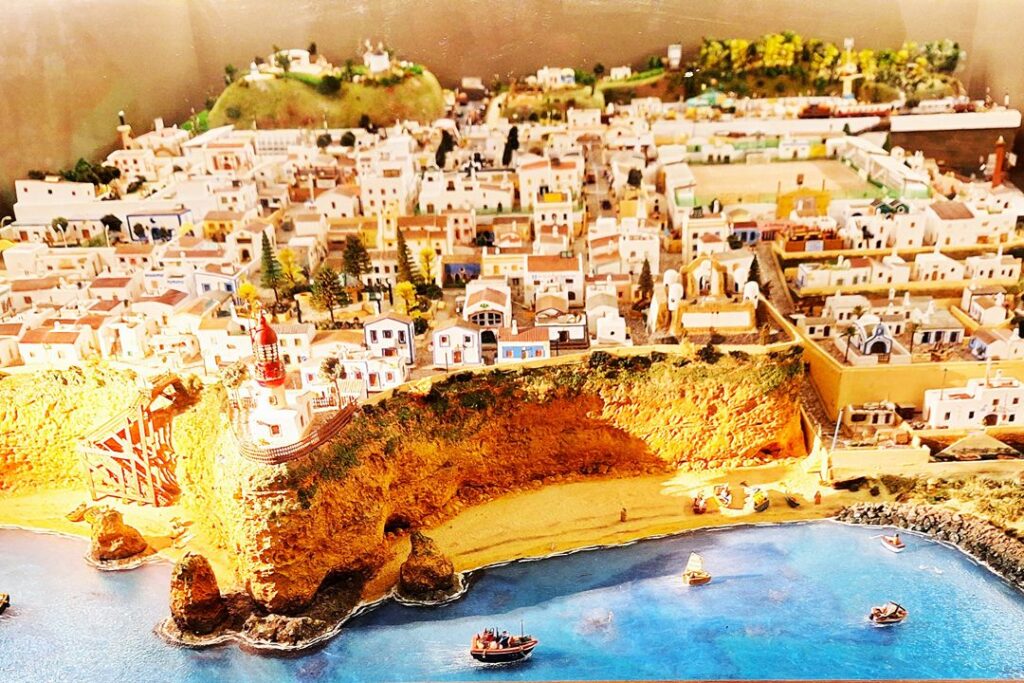
Perhaps the most creative exhibit is a model of a Portuguese village, cleverly constructed to show the coastline and identify major services, infrastructure, landmarks, churches, and more. There’s an interactive control where visitors can identify the various components and even see some action – wait and see, you’ll be captivated. The artist was Pedro Reis.
The highlight of this museum is the Church and Sacristy of Santo António, a temple that belonged to the Brotherhood of Santo António of the Lagos Infantry Regiment. The Sacristy comprises three panels behind the Communion table and a magnificent sacred symbol (a solar monstrance).
The church is a Baroque National Monument with its breathtaking interior covered in gilded woodwork. It is crowned with a barrel-vaulted ceiling covered with intricately drawn paintings. A statue of the patron saint, adorned in a red robe holding Baby Jesus in his arms, is the centrepiece of the wall above the altar. The church is the Algarve’s third most visited monument, after the Sagres Fortress and Silves Castle. It holds religious services once a year, on 13 June, the day of St. Anthony.
The Slave Museum (main photo)
Affiliated with the Lagos Museum is the slave museum, located in the same place as the old slave market. The exhibits are mostly in the form of texts that tell the story:
Lagos’s slave market, built in 1444, was Europe’s first slave market! It was here during the 15th century that the first slaves, captured and transported from Africa, were sold. Many Africans were dispersed throughout Europe, bringing a considerable income to the Portuguese monarchy and merchant classes, as well as a cheap labour force. As the major sponsor of these expeditions, Prince Henry (whose statue appears on the plaza) received one-fifth of the selling price of the slaves. The demand for the indentured labour force was so high that, by 1450, profit on Mauritanian slaves was 700 per cent.
From 1450, and until emancipation in 1867, more than six million Africans would be trafficked on Portuguese ships to Europe and across the Atlantic. The slave museum has a moving slide show with text describing the heart-rending procedure at the slave market on 8 August 1443, when preparations were being made to sell 235 black people. The auction was attended by Prince Henry, whose statue (quite ironically) stands in the square. The chronicler attending the proceeding described the scene:
“Very early in the morning the sailors started preparing their boats to bring the people to the auction. Some had their heads hung low and their faces covered with tears, looking at each other; others were moaning very painfully, looking to the skies. Others hit their faces with their palms and then threw themselves to the ground, others made their lamentation in a song following the custom of their land. Those in charge of dividing the slaves came and started to separate them. They put parents on one side; the children on the other with the children desperately trying to return to their parents. The other mothers would hold their children tightly in their arms and throw themselves to the ground.”
Many European countries are still struggling to come to terms with the abomination of slavery and the transatlantic slave trade. President Marcelo Rebelo de Sousa stated in April 2023 that the country should apologise and take full responsibility for its leading role in the transatlantic slave trade.
Entry: Lagos Museum: 3 Euros. Slave Museum: 1.5 Euros. Open Tuesday to Sunday, 10 am to 1 pm, 2 pm to 6 pm. Address: Rua General Alberto da Silveira 1, 8600-594 Lagos.